The constraint on AI compute is shifting from how much electricity a utility can deliver to how much of it actually reaches the GPUs. NVIDIA says the fix is to stop shuffling power through repeated AC-to-DC conversions and instead distribute it at 800 volts in direct current, a design it built with Google and Microsoft through the Open Compute Project (NVIDIA blog).
From wattage to pathway
For years the worry was raw wattage: could the grid supply enough? That question still matters, but the bottleneck NVIDIA now points to sits further down the line, in how power travels from the utility connection to the accelerator. In a typical AI factory, grid power arrives as alternating current and is converted several times — at the building, at the rack, and sometimes at the server — before it becomes the direct current a GPU actually draws (NVIDIA blog). Each conversion stage sheds a little energy as heat and adds a layer of hardware. At the power levels next-generation accelerators demand, those small leaks stop being rounding errors and turn into a real slice of the operating bill.
What the new power design actually changes
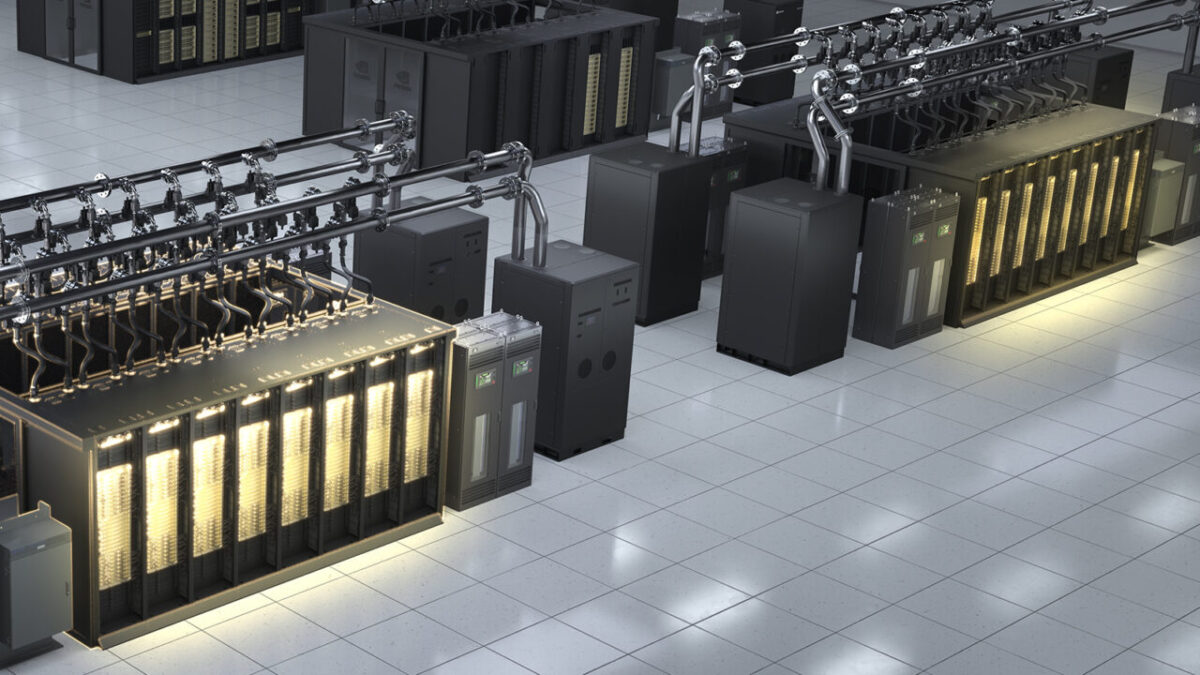
NVIDIA says distributing at 800 VDC collapses several of those conversion steps into fewer ones, so more of the grid’s electricity lands on the compute instead of being spent moving between voltage and current forms (NVIDIA blog). The reference designs NVIDIA publishes under its DSX program lay out how an operator moves from today’s AC base through a hybrid stage and into a fully native 800 VDC facility, treating power architecture, rack-scale compute, and facility infrastructure as one connected system rather than separate purchases (NVIDIA DSX docs). The promise is efficiency, but the mechanism is simply fewer handoffs between the grid and the GPU.
A standard built in the open
This is not a single-vendor specification. NVIDIA, Google, and Microsoft developed 800 VDC together inside the Open Compute Project, and the group published a joint white paper in March 2026 plus the LVDC Solid-State Transformer Specification v0.3 in July 2026 (NVIDIA 800 VDC industry alignment white paper). NVIDIA says more than 80 equipment manufacturers and infrastructure companies are already building products to the specification, which defines common interfaces so power gear from different vendors can operate inside the same facility (NVIDIA blog). An open interface matters here because a data center’s power train spans breakers, transformers, busways, and racks from many suppliers; a proprietary lock-in would stall exactly the buildout the standard is meant to accelerate.
The near-term on-ramp for buildings already standing
Most AI factories now running were designed around AC distribution, and replacing that wiring is expensive and disruptive. NVIDIA’s MGX-compatible 800 VDC power rack, due in the second half of 2026, slots into existing AC infrastructure and delivers 800 VDC to compute racks within the row without requiring changes to the building’s electrical system (NVIDIA blog). Vladimir Troy, NVIDIA’s vice president of data center infrastructure, framed the point directly: “800 VDC unlocks the compute performance and power density required for AI at scale. Through OCP, NVIDIA is working with more than 80 ecosystem companies to give AI factories a practical path forward — not just a future vision” (NVIDIA blog). For site owners, the appeal is concrete: land, power rights, and building shells already paid for are not stranded by the next density jump.
The longer roadmap: three building blocks
Beyond the power rack, NVIDIA sketches two larger pieces. NVIDIA says the row power center is a centralized station for a full rack row that uses an overhead 800 VDC busway to scale across multiple rows and support up to 2 megawatts per row, with availability expected in 2027 (NVIDIA blog). The company describes the DC power block as a facility-scale unit that converts grid power straight to 800 VDC in a single step, enabling direct medium-voltage conversion at the scale operators are planning for the decade ahead (NVIDIA DSX docs). Read together, the three blocks form a staircase: start with a hybrid rack in a building you already own, add row-level distribution as you grow, and design new sites around a facility-scale conversion from day one.
Why this matters before the buildout peaks
Wood Mackenzie projects $9 trillion in global AI and data infrastructure investment through 2040, and the facilities that can absorb that capital will be the ones that settled their power architecture before demand outran their wiring (NVIDIA blog). The pitch is less about one product and more about giving AI factories a staged, vendor-interoperable path so existing sites can raise density without a teardown. The economics only sharpen as racks pull more watts per square meter; the same percentage of conversion loss represents a larger absolute waste at higher densities.
Reading the timeline: what is shipping versus what is promised
It is worth separating the concrete from the roadmap. The MGX-compatible power rack is the near-term, hybrid-compatible piece, targeted at the second half of 2026, and it is the part operators can plan around without rebuilding a site (NVIDIA blog). The row power center follows in 2027, and the facility-scale DC power block is positioned for new construction rather than retrofits (NVIDIA DSX docs). That sequencing is the practical core of the announcement: it lets operators act now while the larger pieces mature, instead of waiting for a perfect native-800 VDC building that does not exist yet.
Who benefits, and how
The staged design maps onto three operator profiles. Hyperscalers building greenfield campuses can skip straight to facility-scale conversion and treat 800 VDC as the native standard. Colocation and enterprise operators with AC buildings get a hybrid rack that raises density without a rewire. And equipment vendors get a fixed specification to build against, which is why more than 80 manufacturers signing on matters as much as the technology itself (NVIDIA blog). Each group gains something different, but all three need the standard to be real and shared rather than a single company’s roadmap.
The open-standard bet, and its risks
The biggest caveat is maturity. The LVDC Solid-State Transformer Specification is at version 0.3 as of July 2026, which signals an interface still being finalized rather than frozen (NVIDIA 800 VDC industry alignment white paper). The $9 trillion figure is Wood Mackenzie’s projection of where investment is headed, not a guarantee that every planned facility will be built, and the efficiency gains depend on the whole power chain adopting compatible gear. The bet NVIDIA, Google, and Microsoft are making is that an open, staged standard — not a proprietary leap — is what lets operators keep current buildings while chasing the next density jump (NVIDIA blog).
Where this fits in NVIDIA’s broader AI factory push
The 800 VDC work sits inside a wider campaign to own the full stack of AI infrastructure, not just the accelerators. NVIDIA and its partners have recently framed a large financing push aimed at the same infrastructure wave, signaling that the company sees power and capital as the gating constraints on AI scale (zBrandco: NVIDIA’s broader AI factory financing push). It has also deepened regional compute and talent programs, such as Indonesia’s first university AI center built with NVIDIA, which shows the buildout argument extending beyond North American hyperscalers (zBrandco: Indonesia opens first university AI center with NVIDIA).
The bottom line
The 800 VDC debate is ultimately a question of efficiency at scale: shaving conversion losses matters precisely because the fleets are enormous and the power bills are too. NVIDIA’s answer is an open, staged standard that lets existing buildings raise density now and new sites convert power once, at the grid, instead of many times along the way (NVIDIA blog). Whether operators adopt it will depend less on the physics than on how quickly the 80-plus vendors turn the July 2026 specification into gear they can actually buy and install.
Editorial note: Citation cleanup: we trimmed duplicate citation links that repeated the same source after multiple paragraphs. Every fact and quote is unchanged; the source remains cited where each claim appears.