
Most redaction software works like a censor with no comment. It blacks out names and numbers, then moves on, leaving reviewers to trust that nothing sensitive slipped through.
A new paper on the arXiv computation-and-language track proposes a different bargain: tell the model what to hide in ordinary English, and it will explain, line by line, why each piece of text disappeared arXiv paper.
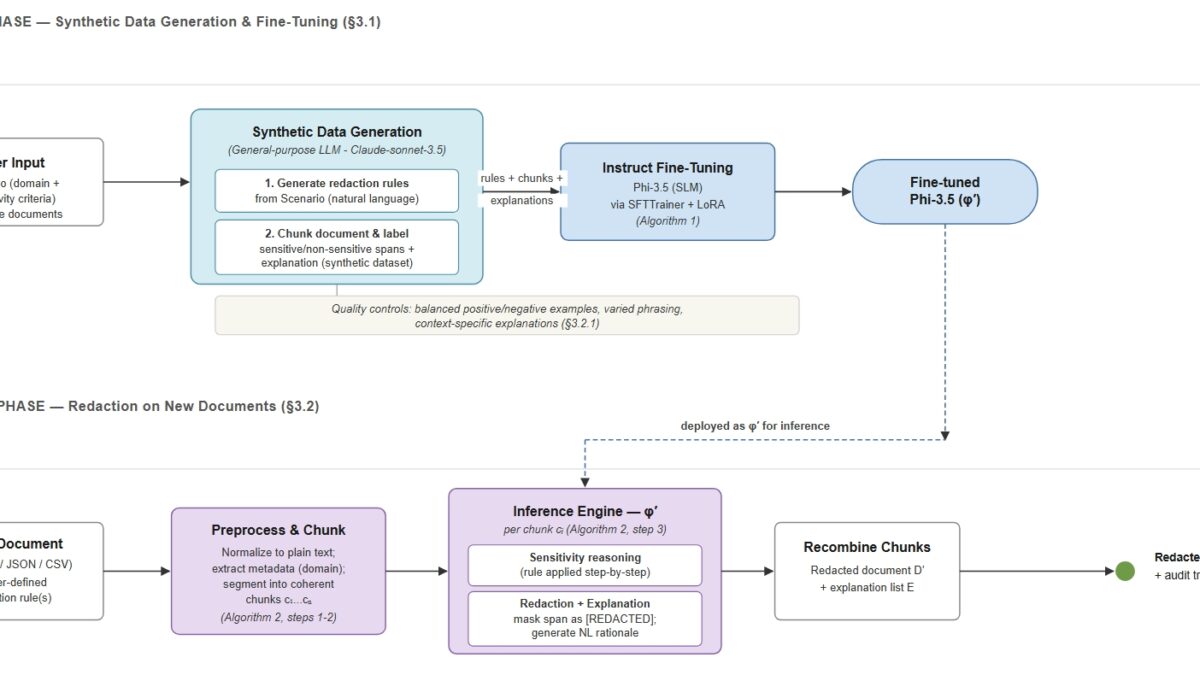
The approach, which its authors call domain-agnostic text redaction from natural language rules, treats sanitization as a reasoning task instead of a pattern match arXiv paper. A general-purpose large language model first turns a user’s definition of “sensitive” into a set of plain-language rules. Those rules then fine-tune a smaller model that walks through a document step by step, flags the matching passages, and writes a natural-language justification for every redaction it makes.

Conventional tools handle structured identifiers such as names, account numbers, and email addresses well. But they offer no transparent reason for what they removed, which the paper argues makes them hard to audit DOI record. The new method instead highlights the specific rule that triggered each decision, so a human reviewer sees not just what vanished but the logic behind it.
“Unlike traditional text sanitization, this method enables a user to conveniently define any sensitive information… in natural language,” the researchers write, framing the system as a way to stretch redaction past rigid PII templates toward unstructured material such as legal terms or internal policies arXiv paper.
The catch: rules written by another model
The trade-off is real. Because a general LLM generates the rules, the quality of the redaction depends on how well that model understood the request. The paper reports a reconstruction-based metric that estimates the chance of recovering redacted text from the sanitized document, and claims high reconstruction error alongside high redaction precision DOI record. In plain terms: the harder it is to reconstruct what was hidden, and the fewer false redactions, the better the system performed on the tests the authors ran.
The work arrives inside a broader push to make automated decisions explainable rather than merely correct. As one zBrandco analysis argues, governing AI behavior well requires a shared technical vocabulary before the laws can mean anything AI rules need a shared technical language. A redaction tool that can state its own reasoning is a small, concrete instance of that principle.
If the method holds up outside the lab, its first homes are likely the high-stakes, high-volume rooms the paper names: legal discovery, medical documentation, and corporate information governance. There, a redaction that cannot explain itself is not just opaque — it is a liability waiting to be challenged.